
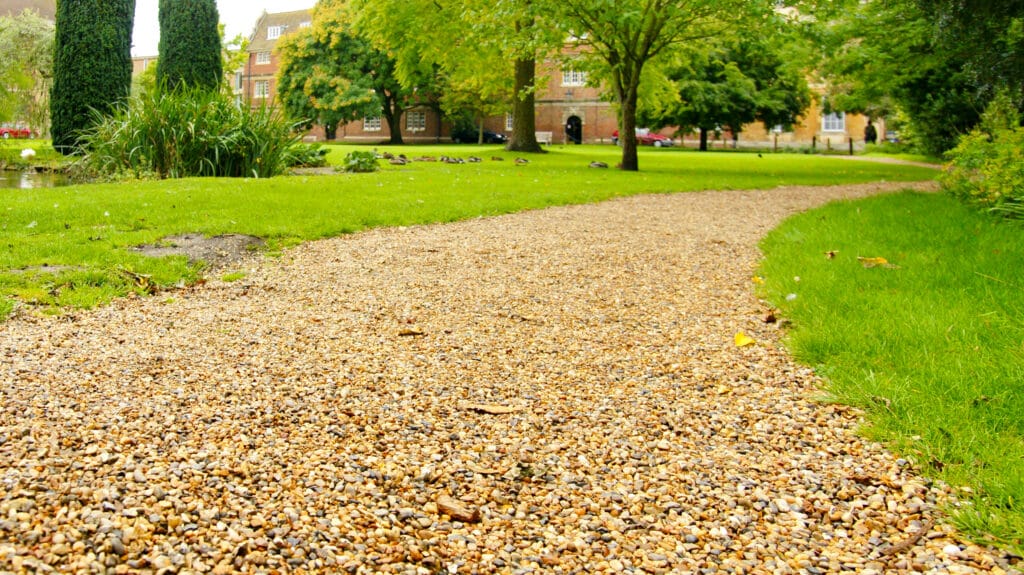
The gravel that holds up on a driveway is almost always angular crushed stone that locks when you compact it — not smooth river rock and not a single thin layer of decorative pebbles. If you came here asking what type of gravel is best for driveways, start with that distinction, then pick a size and color that matches how you actually use the pad.
JBS Express McKinney stocks driveway-capable gravels and the dump trucks that deliver them. Call (469) 972-8818 with the width of your gate and a photo of the current surface so the load matches the job.
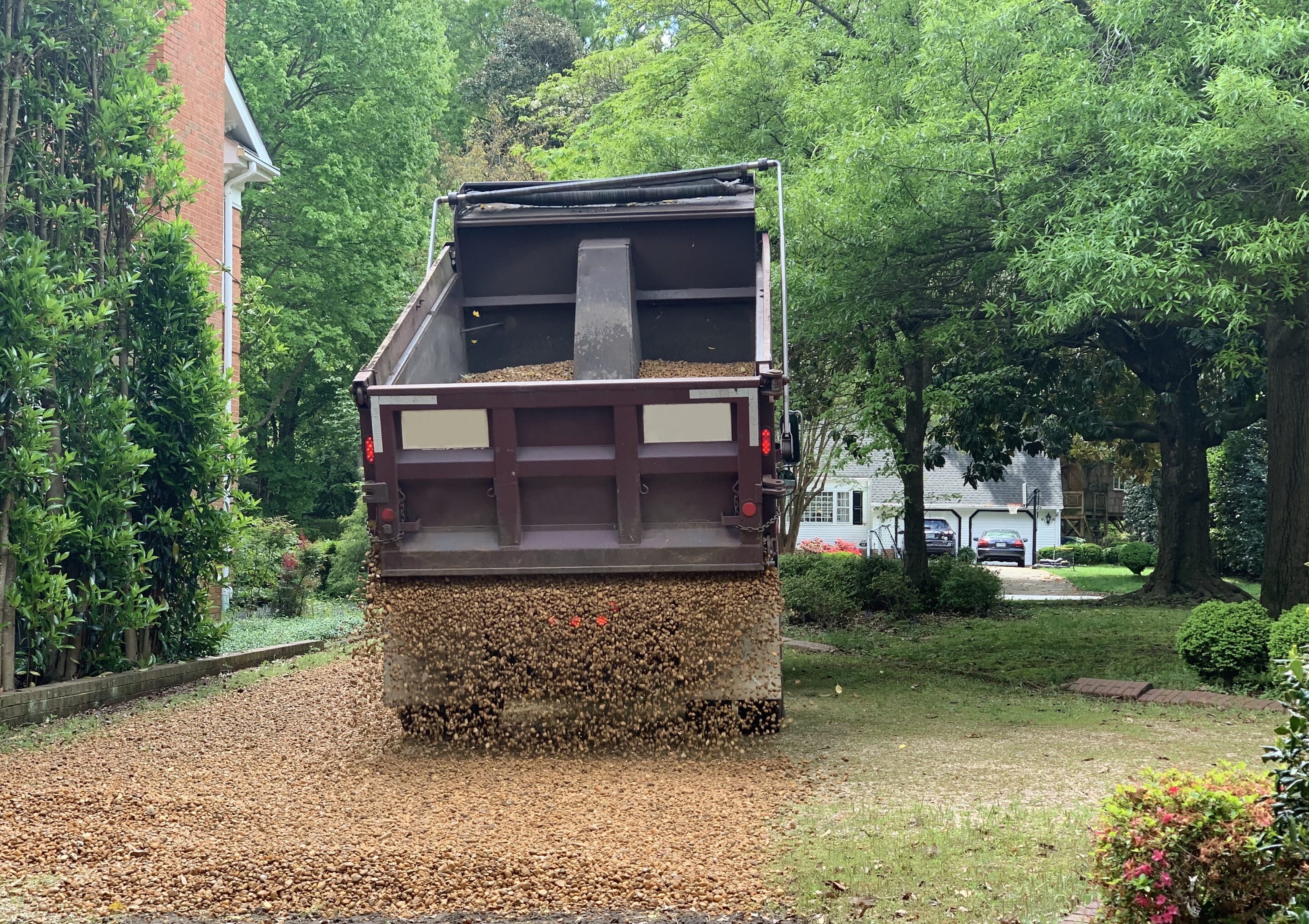
Table of Contents
- What Gravel Works on a Driveway
- Crushed Stone vs Rounded Rock
- Base, Clay, and Drainage
- Color and Decorative Options
- How Much Gravel You Need
- Dump Truck Delivery
- FAQs
What Gravel Works on a Driveway
A driveway has to take turning tires, parked weight, and North Texas storms. Gravel for driveways needs three traits:
- Angular faces so pieces interlock instead of rolling.
- A mix of sizes (or a designed base plus a wearing course) so voids fill and the crust stays firm.
- Enough depth on a compacted base, especially on clay that moves with moisture.
Decorative rounded stone can be a top dressing in a bed next to the drive. As the only wearing surface, it ruts, throws from tire spin, and works into the lawn. That is the usual reason a “pretty” driveway fails in a year.
Crushed Stone vs Rounded Rock
Crushed stone and quarry blends have broken faces. Under a plate compactors or repeated traffic, those faces jam together. River rock and many decorative gravels are tumbled. They behave like ball bearings when a truck turns into the garage.
If you like a darker finished look, that does not automatically mean river rock. Tejas (Blackstar) is a dark gravel many customers use in beds and as a visible course; confirm at the pile whether the pieces are angular enough for your traffic. Daily work trucks and a weekend car are different loads.
Pea gravel is comfortable to walk on and poor as a standalone driveway. Keep it for paths and play areas. Decomposed granite can work on light-use drives if it is installed in lifts and edged, but it is not a magic substitute for a crushed base. Details live in the decomposed granite guide.
Base, Clay, and Drainage
McKinney-area soil is often clay. Clay holds water, then shrinks. A pretty surface on pumping clay becomes washboard. For a lasting gravel driveway:
- Strip organic soil and soft spots.
- Set a compacted crushed base thick enough for the vehicles you actually park.
- Crown the drive or give water a path off the wheel tracks.
- Edge the sides so the wearing course does not migrate into the turf.
- Add the finish gravel and compact again.
Skipping the base to “just put some gravel on the dirt” is how loads disappear into mud. If the current drive is already gravel but full of holes, you may need to regrade and add base — not only a cosmetic top-off.
Watch the first hard rain after a new wearing course. Water should sheet off the crown or along a defined edge, not sit in the wheel tracks. Puddles on a new gravel drive usually mean the grade is wrong or the clay is pumping through a thin spot. Adding more of the same decorative stone on top of a pond does not fix it.
If the drive is also the only path for a dump truck later (mulch, soil, more gravel), leave a reinforced center or a thicker section where the truck will sit. A pretty thin finish that a delivery truck punches through on week two is a frustrating way to learn about base depth.
Drainage rock belongs in the wet spots and along culverts, not as the parking surface. See rock for drainage when the problem is standing water rather than ruts.
Color and Decorative Options
Once the structure is right, color is a preference. Light stone shows less heat absorption but shows tire marks. Dark gravel hides stains and looks crisp next to green planting. Browse gravels in person; phone photos lie about both color and size.
A common mixed design is crushed base you never see, then a thinner decorative wearing course. That still only works if the wearing course can lock. Do not put polished pebbles on top of a base and call it a driveway.
How Much Gravel You Need
Measure length × width × depth. A wearing course is often a few inches on top of base; a full rebuild is thicker. Convert cubic feet to cubic yards (divide by 27), then ask the yard to convert to tons for the stone you picked — density is not the same for every pile.
The material calculator is a starting point. Add extra for irregular edges, a crown, and the first year’s settling. It is cheaper to schedule one well-sized dump than to starve the surface and rut it immediately.
Dump Truck Delivery
Driveway gravel almost always arrives by dump truck. You need a place the truck can sit, a spot to dump that does not block the only exit, and overhead clearance. If the truck cannot reach the pad, you will be wheelbarrowing tons. Say so when you request a quote.
Flatbeds are for stone that should not be dumped — slabs and palleted chop. Gravel wants a dump body.
FAQs
What type of gravel is best for driveways?
Angular crushed gravel that locks, on a compacted base, with drainage off the wheel path. Rounded decorative rock is the usual mismatch.
Can I use landscaping gravel on a driveway?
Some landscape gravels are crushed and suitable. Many are rounded or too small. Match the pile to traffic, not to a backyard photo.
How deep should driveway gravel be?
Deep enough that tires never punch through to clay after rain. That is a base-plus-wearing-course conversation, not a single magic number for every house.
Will Tejas black gravel work on a driveway?
It can as a visible course if the particles lock and the base is right. Confirm the actual pile and your vehicle weight at the yard before you copy a bed installation onto the drive.
Do you install gravel driveways?
JBS supplies and delivers the material. Spreading and compacting is DIY or your contractor. We help you size the load.
Should I wet the gravel when I compact it?
A light dampening can help some crushed mixes knit. Soaking clay underneath does not. If the subgrade is already pumping, stop and fix drainage and base instead of adding water and hoping.
How often does a gravel driveway need a top-off?
After the first season you will see where turning tires throw stone. A small top-off in those fans is normal. If the whole drive sinks, the base was thin or the clay was never addressed.
Independent plant and soil context for the rest of the yard: Texas A&M AgriLife Earth-Kind landscaping. For the stone itself, call (469) 972-8818 or stop by the yard.
Next step: contact JBS or request delivery on the quote page.
What type of gravel for a driveway (and driveway gravel stone)
Searches for what type of gravel for a driveway and driveway gravel stone are the same decision: angular crushed stone that locks, on a compacted base, with a wearing course thick enough that tires never punch into clay. “Driveway gravel stone” is not a special SKU — it is crushed gravel sized for traffic, not decorative pebbles from a bed photo.
If you already have rounded decorative gravel on the pad, cleaning it will not make it lock. Replace the wearing course with a crushed mix, or keep the decorative stone in the beds and rebuild the drive. Browse gravels at the yard and say it is for cars, not a flower bed.